
RxRewired – Ep 02: Will AI Get Pharmacists Paid Before It’s Too Late? | APhA CEO Michael Hogue
RxRewired Podcast
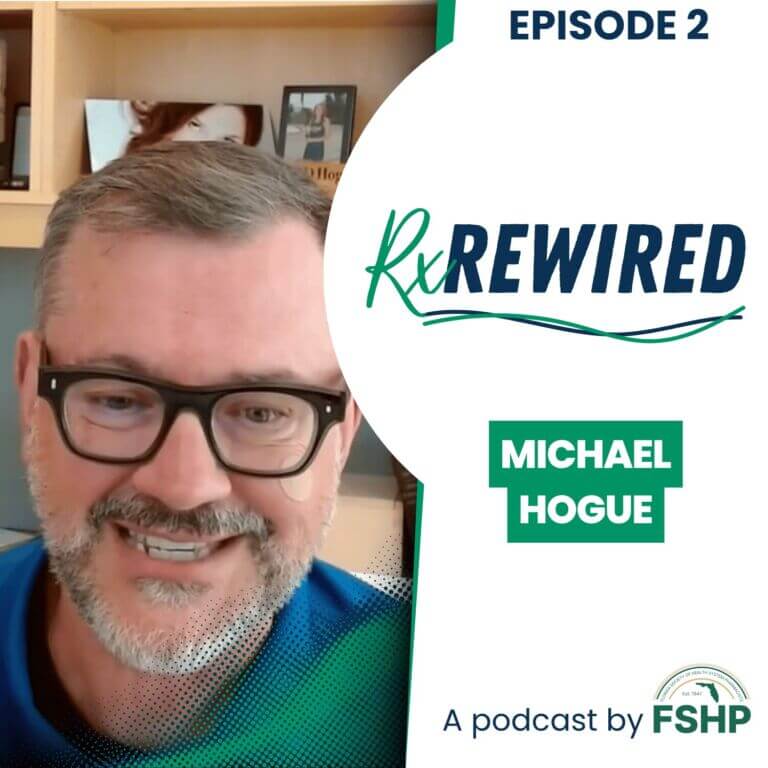
Publish Date: September 2, 2026
We dig into the surprising truth about AI's role in pharmacy with APhA CEO & EVP Michael Hogue.
Are pharmacists ready for the AI revolution?
In this thought-provoking episode, Dr. Michael Hogue, the Executive Vice President and CEO of the American Pharmacist Association, challenges the conventional fears surrounding artificial intelligence in healthcare.
He argues that rather than fearing AI, pharmacists should see it as a transformative tool that can enhance their roles and improve patient care.
Watch This Episode
Like/Follow/Subscribe on your favorite podcast listening platform to get notified when new episodes drop.
Join host Madeline Camejo and co-host Jeremy Espeut as they dive deep into the current landscape of AI in healthcare.
You'll discover how health systems are already implementing AI to streamline prescription renewals and improve patient outcomes.
Dr. Hogue shares compelling insights from a recent Washington Post article revealing that the pharmacist's role is unlikely to be replaced by AI due to the vital relationships they maintain with patients.
In this episode...
We break down crucial topics such as:
- The role of AI in reducing administrative burdens for pharmacists, allowing them to focus on patient care.
- Real-world examples of how pharmacists can leverage AI to prove their value in healthcare systems.
- The importance of data exchange between community pharmacies and health systems to enhance patient safety and medication outcomes.
The stakes couldn't be higher: as healthcare becomes more complex, the need for pharmacists to demonstrate their value has never been more critical.
Dr. Hogue emphasizes the need for systemic changes that recognize and reward the contributions of pharmacists in patient care.
This episode is essential listening for pharmacists, healthcare professionals, and anyone interested in the future of healthcare.
Tune in to understand how embracing AI can empower pharmacists to make a lasting impact on patient outcomes. Don't miss this opportunity to reshape your perspective on the future of pharmacy!
Episode Transcript
ExpandEpisode Transcript
Michael Hogue
Maybe what I'm going to say may sound a little bit controversial. There may be those that disagree with the statement. I'm gonna make a fairly declarative statement. I think pharmacists are ready for this transition to happen, but the economics have not caught up.
Madeline Camejo
Welcome to RX Rewired, Inside What's Next. I'm Madeline Camejo.
Jeremy Espeut
And I'm Jeremy Espeut.
Madeline Camejo
And today we are joined by someone shaping many of the conversations happening across healthcare. Dr. Michael Hogue is the Executive Vice President and Chief Executive Officer of the American Pharmacist Association. His work extends well beyond pharmacy, bringing together clinicians, health systems, policymakers, and technology leaders to think about what healthcare is coming to next.
Michael, welcome.
Michael Hogue
Thanks so much for having me. I appreciate it.
Madeline Camejo
So, I have a question. Every time I go to meetings now everywhere, whether it's ASHP, HEMS, Vive, Delph, you know, digital health conferences, everything was talking about AI and pretty much the deployment of AI was mostly talked about. Now, a year later, you're seeing all these health systems deploring AI.
Utah just now allowing AI agents to automatically renew prescriptions without having patients seeing their doctors. You see CVS integrating AI in every piece, whether it's part of their PBM, they're looking at authorizations of prescriptions, including fulfillment centers. So it's here.
You know, we're already watching AI reshape law, engineering, other institutions. And change is happening fast. And when that happens, sometimes there's a creation of fear.
And so, my question to you is should pharmacists be afraid of AI?
Michael Hogue
Well, that's a great question. I mean the reality is that we have to look at AI as a tool. You know, you you're not gonna stop AI from being integrated into systems and into care of patients. And you just have to look at it's a tool just like any other tool. And so you have to figure out how do we harness the power of this tool to be able to help us do good work.
And if you think about all the things that pharmacists do, you know, whether it's at patient's bedside in a health system or you know remotely perhaps, depending upon what the role of the pharmacist is, or even in a community pharmacy, there are a lot of needs out there that patients have. And the job of a pharmacist is to make medicines work and to help make medicines work, regardless of where we're at in the healthcare system.
And frankly, my observation is that they're not enough pharmacists to be able to get that work done effectively because we tend to get tied up with administrative tasks and busy work that is really not the things that we want to be doing.
So, if we can leverage AI to help reduce the administrative burden and to help us get to the patient faster and to help us provide care and ensure those great medication outcomes, I think AI needs to be embraced and we need to we need to figure out how to leverage that tool to make our lives better and help us focus on the things we enjoy doing.
Jeremy Espeut
That's a great point. So, what you're saying is the real question isn't whether AI will replace the pharmacist. It's more so whether healthcare recognizes what the pharmacist can contribute to beyond just a transaction, right?
Michael Hogue
Right. And you know, you have to look at sources of studies and things, but I'll tell you the it was the Washington Post actually about two months ago published a pretty neat article that was based on a university's data. I don't remember which university it was, but they analyzed the Bureau of Labor and Statistics job classifications for just about every job you could think of in America.
And they had a likelihood scale on what is the likelihood that this particular job would be completely replaced by AI in the future. And there were some interesting data in there. But I of course looked up pharmacists to see what they said about pharmacists, and they said that it's virtually impossible and unlikely that a pharmacist job would be replaced by artificial intelligence because the pharmacist's relationship with patients is critical to ensuring appropriate medication outcomes. Because what we do actually as pharmacists in ensuring appropriate medication use and outcomes is largely based in relationships that we have with patients. Whether those are acute or they're chronic relationships, they're still important relationships. And so it was a recognition really by folks who are outside a pharmacy that the role of a pharmacist is so critical in our healthcare system that it's highly unlikely that a pharmacist role would ever be replaced by AI.
Madeline Camejo
So that I'm sure a lot of pharmacists are gonna feel better about that. I know I do, but the question maybe we're asking is wrong. So, if health care, if AI is gonna create capacity and healthcare systems are looking to continue to move things forward, and as you see healthcare systems today manage complex you know, patients, they help avoid readmission, but we're still being billed under the physician through collective practice care incident to bill models, right?
And then you look at the community pharmacist who kind of does the same thing. I think they find duplications, they find interactions, they also help navigate patients with complex treatments and they help prevent hospitalizations. But before that, and that's all taken place while they're you know looking at answering phones and l dealing with insurance problems. But the question is then that value, CMS doesn't see it, whether we're, you know, whether we're in the hospital or whether we're in community. CMS doesn't see that value because it's not documented anywhere, it's not sent anywhere. So the value exists, but we struggle to show that value to other folks that would help us become more successful in recognizing the measure and reward what pharmacists have been doing out along.
So, the question would be then, do we, how do we then mix so that we can get paid for what we actually do?
Michael Hogue
Well, I mean your question's a fundamental question about, you know, the systems that we have that that recognize pharmacists for the care services that they provide. And so maybe the best thing for me to do is just share with you real world examples of what we're working on in Washington right now related to this.
The Office of the National Coordinator of the Department of Health and Human Services, HHS, is responsible for developing the national electronic data transmission standards for our country. So, when health claims are transmitted between payers and healthcare providers, or when there's a healthcare provider to provider electronic data interchange and so forth, that's all regulated by ONC. So ONC sets the standards for that.
APHA has been meeting on a very, very regular cadence. And when I say a regular cadence, I mean sometimes multiple times a week to talk about how we can improve the data interchange between community-based pharmacies and health systems, and even within health systems, how we can ensure that pharmacists who are embedded in care systems are able to actually see and access the far outpatient pharmacy records of a patient.
We don't have good exchange of data between the pharmacy ecosystem and the health system ecosystem. And this is a major problem that leads to drug-related morbidity and mortality because the healthcare professionals can't see what each other's doing.
So, your point, Malin is so correct that we've had a difficult time proving in the past where the value add is of the pharmacist on the healthcare team, but it's largely been because we've not had pharmacists included in those data exchanges.
And you know, not to make this answer any longer than it needs to be, but I do want to make this point. When meaningful use laws and regulations were passed several years ago, they only really applied to physicians, to doctors' offices and private physician practices and health systems. They didn't apply to pharmacy. They didn't apply to behavioral health. They didn't apply to physical therapy. So, there's a lot of outpatient clinicians out there that are not connected through the meaningful use standards. ONC recognizes that and we're working really, really hard right now on solutions to solve this problem.
By setting standards and putting standards in place that will allow community based pharmacists, for example, and transitions of care pharmacists and hospitals to be able to communicate with each other and ensure that the patient's medication transitions happen correctly is one example.
So, I am optimistic that we are on a path that's moving, relatively quickly to solve this problem once and for all because it is a huge issue. It's hard to prove value if you don't have the documentation of the care that exists and wherever it's being provided.
Jeremy Espeut
That's a good point. So, speaking of transitions of care, what could a digital transition of care model look like and how could it be possible with AI, Michael?
Michael Hogue
Well, let me just, you know, I know that many of your listeners are pharmacists that are gonna be hearing this and this sounds maybe like a command of the obvious, but we have to understand the way this system works right now and we have to be able to compare it to the past because unfortunately many people who have control of the systems that could you know are designed for providers to be able to provide care to patients, these computerized systems that support us are based in old ways of doing things.
They think you know the way things were 30 years ago. Thirty years ago, community-based physicians had admitting privileges to local hospitals and went in and saw their own patients in the hospital and then came out and saw their patients in clinic. Where does that happen anymore? Nowhere. Nobody's doing that anymore. Now we have hospitalists, okay?
So now you've got community-based physicians that are seeing patients in the outpatient setting, managing their patients, patients being transferred into inpatient settings seen by hospitalists. Hospitals have formularies that may be different than the prescription drug plans formulary that the patient had when they were outpatient.
So, the hospitalists may be discharging a patient on medications that are different than the ones they were on when they were outpatient. And then you've got a community pharmacist that's having to try to make sense of it all, without full visibility into the entire care continuum of the patient.
That is an incredibly inefficient and dangerous system for patients. It's incredibly dangerous for patients. And I could tell you tons of very good stories of patients that I know of who've experienced adverse events as a result of that broken system.
So, we've got to leverage AI to be able to help us improve this system so that all of those components actually have visibility into what's going on with the patient's records, what's going on with the patient's prescription drug therapies.
Because prescription drugs are the most cost-effective intervention typically in healthcare. However, for every dollar we spend on prescription medications in this country, in 2017 data said that we spend a dollar and fifty-five cents on drug-related problems. Pharmacists are positioned to ensure that we're not spending all that money on drug related problems. And if we can leverage AI, we can establish systems that will allow inpatient providers and pharmacists and outpatient community pharmacists to be able to communicate with each other effectively and ensure that patients have the medicines they need at the right dose, the right time, and with the right outcomes. And that's where we need to move to.
Got to get to an outcomes-based expectation related to medications. Can't be about just the cost of medicine, it has to be about the outcomes the patients achieved through appropriately used medications. And AI can help us with that.
Madeline Camejo
And I agree, Michael. I think on in many aspects, AI can definitely identify high risk patients. We already see it today. It can create high risk patients and kind of sort our work into the patients we need to see first, right? That and that's already happening in a lot of the clinical workflows.
But my concern is, you know, pharmacists have advocated for years, you know, for that clinical, how do we get paid for clinical services?
And so, if we have AI which actually removes the or helps us identify these patients, then how can we ensure that policy, you know, make sure that we pay for that so that for the first time when AI may provide all this evidence, how can then we change so that pharmacists actually gets paid for what we're doing?
So, the question I'm gonna ask is so which comes first? Do we need payment models before the profession changes? Or do we measure practice transformation and policy all have to move together?
Michael Hogue
So, you know, maybe what I'm going to say may sound a little bit controversial. There may be those that disagree with the statement that I'm gonna make a fairly declarative statement. I think pharmacists are ready for this transition to happen, but the economics have not caught up to make it possible.
So, I think that you know, based upon my conversations with pharmacists that work in community based pharmacies, whether it's chain pharmacies or independently owned pharmacies. My observation is that pharmacists want to be doing this work, they feel prepared to do this work, and they're ready to do it. But you have to have enough excuse me, yeah enough critical mass of cash flow business, actually money coming into the business to support the pharmacists being able to focus their time, energy, and attention to resolving drug related problems in this work. So, you know, it's the old saying, no money, no mission.
So, what has to happen? We're at the point now that, you know, I believe that transformation is happening in community pharmacy already. We see many signs of it, and I could give you many very specific examples of where I see it happening. But the payment has got to catch up quickly.
So, I would say the most important thing we can do right now is to get the payment model fixed, the payment system fixed. And you know, if you'd like we can dive into what's happening right now around these payment model changes that are happening, because I do see some things that I think are potentially ripe to spread across the country that could help solve this payment problem fairly quickly.
Jeremy Espeut
Yeah. Let let's go into it a little bit.
Michael Hogue
Okay. Well, so, you know onboarding pharmacists as providers has to happen through the health plan. And historically pharmacies were not established or set up to be able to bill a health plan. Pharmacies tend to do electronic adjudication of claims with pharmacy benefit management companies. But the process for billing for health claims is very different and the standards for medical care that includes pharmacist care are different.
And so, one thing we have to do is we have to make sure that we can onboard pharmacists with health plans in a very seamless way. And so APHA's been working really hard to partner with health plans to identify mechanisms to effectively onboard pharmacists either you know in practice groups or individually into the health plan as providers and to make that a seamless process that's not onerous, that you don't have to do it in an onerous way, you know, for a thousand different health plans, and there are that many or more across the country.
And we're also working very diligently to credential pharmacists. The way that that's happening is Pharmacy Profiles is a company that was actually started by APHA based upon the profession of pharmacies call for a standardized way to credential pharmacists with health plans.
Health plans, in order to meet federal regulations, have to have a process for credentialing pharmacists that's NCQA accredited, that's NCQA approved. Right now, the only credentialing verification organization nationally that can do pharmacist credentialing is Pharmacy Profiles.
And so, what Pharmacy Profiles is doing now is working with large employers that employ lots of pharmacists, with independent pharmacy practice groups like CPESN USA and others to be able to do delegated credentialing on behalf of the group of pharmacists that are working together, get those pharmacists credentialed with the health plans.
And then on the back end, you have to have the systems that allow the seamless billing to occur in the way that data exchange needs to happen between a health plan and a pharmacy.
And what we're trying to help the health plans understand is that the data exchange really can look exactly like data exchange happens with physician office practices. It's just different types of data and clinical intervention that you're collecting from a pharmacist than you would be collecting there.
So, we have a major national initiative on this right now at APHA. We're working very hard with the health plans to get them onboarded. And there's nothing today that stands in the way of private insurance companies providing coverage for and payment for the care services of a pharmacist. There's nothing that stands in the way.
And in fact, CMS has acknowledged that if state Medicaid agencies will submit a plan waiver, they will be approved to cover the care services of pharmacists. And many, many, many states now have done so. They've submitted plan waivers, and the state Medicaid plans now have the authorization to be able to pay pharmacists for the care services.
Working out this credentialing framework, getting the details of the digital transformation. And now you can see why we're working so closely with ONC, because to have the right regulatory structure in place, we have the right data transmission standards in place behind the scenes. It's just a matter of getting the pharmacist enrolled in credential with the health plan, and we're off to the races. Then the opportunities come from the health plans and ensuring that we can provide this level of care.
So, it's a lot of things that are happening. And you gotta get that momentum going. Once you get that momentum going, payment happens, and payment can happen in critical mass enough to actually flip the whole model of the way community pharmacies provide it. And I see that's happening very rapidly in certain parts of the country.
Madeline Camejo
And I love that, Michael. I think not a lot of people understand that. And is it better than we also work with ASHP to get hospital pharmacists credentialed through the same platform so that we're all working in tandem because it my concern is we have one side working on one thing and other side working on other and at the same voice, this is why I always feel pharmacists don't have one voice.
And I think it's important that if you're working so hard on that, then we should be doing the same thing on the hospital system side to where we're having pharmacists credentialed through the same so we have one national platform and not have to then depend on whether physicians or not allow us to be providers where we really need to be.
Michael Hogue
Yeah, and then of course in the health system side you've also got the issue of privileging, which is a little different than credentialing. So, health systems have to have a process internally for the privileging process and ASHP's been working very diligently on that. I'm very pleased to tell you that, you know, Sam Calabrese, the new CEO of ASHP and I are good friends.
ASHP and APHA meet our government affairs staff on a weekly basis to coordinate our efforts in Washington to work on things together. We’re very good about that, and we're working on this credentialing thing together. So, we are in fact coordinated and working together.
APHA is working within CPA through CPSN USA with the independent pharmacist as well on the credentialing thing. And then AACP is working very closely with us because many of the catalytic initiatives that happen in you know ambulatory or outpatient care have been precipitated by those jointly appointed academic faculty members between schools and colleges of pharmacy and health systems. Those are a lot of those folks that have really been the innovators over years with health systems to try to make that happen.
So, AACP is also working very closely with us on this credentialing thing. So, while we have had, there's no question that we've definitely had problems in the past with pharmacy not having a unified voice and moving forward, I feel as though the in the current environment, as it specifically relates to credentialing and privileging and getting pharmacists onboarded as providers within health systems. I think APHA, ASHP, NCPA, all of the organizations are more aligned than we've ever been and we're all pressing very hard. We're working very closely with the National Association of Chain Drug Stores to to get NACDS along and help get them working together with us to move this professional.
There's momentum building. There really is. And you know, it's I think we all want it to happen yesterday. Yesterday would have been a better day than to today, but we'll take it as quickly as we can get it and we're gonna press really, really hard to try to make it happen.
But yeah, I agree with you. We've gotta all be coordinated. We can't be working cross purposes. We've all gotta be together and my perspective is that we're more together than we've ever been and I'm hopeful that we're gonna get there.
Jeremy Espeut
So, Michael, let me leave you with one final question. If Dr. Oz called tomorrow and gave you one opportunity to change policy at CMS, what would you ask him to do first?
Michael Hogue
Yeah, changing policy at CMS. I'm gonna tell you, I there's a low-hanging fruit ask that we've actually made to Dr. Oz. In fact, I saw Dr. Oz earlier this week, and he's probably getting tired of hearing me ask for this one thing.
It's a simple thing, but it's so important and it's so impactful. We have 60,000 board-certified pharmacist specialists in the United States. We're a small profession, 340,000 pharmacists across the country. 60,000 of our of our pharmacists across the country are board certified pharmacy specialists.
Many of those board certified pharmacy specialists are working embedded with physicians in medical practices. They're, we call it ambulatory care, but that terminology is foreign to everybody else. It's, that's a pestering frustration of mine. I think it's a mistake. I think what pharmacists do is primary care, and I think we need to jettison the term ambulatory care and call it primary care, but with pharmacists embedded in physicians' office practices.
And back in 2021, the Biden administration put out a guidance from CMS that said that pharmacists could be considered incident two providers, but only at the very lowest minimal time incident to billing code of nine nine two one one. And so that is pitiful. It's like twenty-two or twenty-four dollars for that particular encounter. And you know, that doesn't even begin to look at the complexity of the kinds of problems that pharmacists are solving together with physicians.
And, you know, I was an ambulatory care pharmacist for most of my career, and I can tell you I spent a lot of time with patients helping them get their medicines right. And, you know, so what we've made the one ask of Dr. Oz is it's time for CMS to revise and publish new guidance that allows medical practices, health systems that employ pharmacists in outpatient care settings to bill for the pharmacist time using the entire incident to coding structure nine nine two one one through two one five, that it needs to be based on the same criteria that an advanced practice nurse or a physician associate or physician assistant would use.
And that's low-hanging fruit and it's entirely within the authority of the CMS administrator and the HHS secretary to make that happen. And it's very, very easy to fix this. So, we're pressing really hard with CMS that we get this done. And we want to see that happen with this next Fall’s, with this coming Fall’s physician reschedule finalization. It needs to happen, needs to happen now, and it would be a quick solution that would generate great revenue.
Now, that's not going to help the community pharmacists, okay, with getting paid for their services. Let's get the low hanging fruit, let's make this win happen, and then we'll continue to focus on the community pharmacist provider status as we move forward. And I think that would be my ask of Dr. Oz today.
Madeline Camejo
That's a great ask.
Jeremy Espeut
Sure. So, I have a feeling we just opened up another conversation because to your point, if this pathway existed already, we would no longer be asking how can AI change pharmacy. We more so ask, what's the next role for the pharmacists?
Madeline Camejo
Yeah. And Michael, thank you. Today we examine how AI can make pharmacists valuable, visible, and connect value across patient journey and potentially change how pharmacists are gonna get paid in the future.
But fifteen years from now, what is the pharmacist of the future actually gonna look like? I don't know. Stay tuned for part two.
A big thank you to those who contributed to this episode of RxRewired!
Guest: Dr. Michael Hogue, APhA CEO and EVP
Hosts: Madeline Camejo & Jeremy Espeut
Produced by: Scott Kjelson
Edited by: Scott Kjelson & Jeremy Espeut
Recorded at: Epic Podcast Studios
Discuss this in the FSHP Community
The FSHP Community is open to members and nonmembers. Join the conversation!