
Expanding Access and Excellence: Ambulatory Care Pharmacist Integration & Billing Under CPT 99211
Special Insights
Written by:
Emilie Collongette, PharmD, CPh, BCMTMS
Daniela Luzardo, PharmD
The integration of pharmacists in the outpatient setting transforms healthcare delivery. Ambulatory care pharmacists can optimize medication regimens, expand access to care, and reduce administrative burden.¹ This collaborative model supports goals related to quality, safety, and value-based metrics.
In Florida, pharmacists may practice under a collaborative pharmacy practice agreement for designated chronic health conditions when certified by the Board², after completing the board‑approved initial 20‑hour course and meeting other requirements. In addition, a Consultant Pharmacist may provide medication management services within the framework of a written collaborative practice agreement in specified health care facilities.³

Understanding Incident to Billing and CPT 99211
The Centers for Medicare & Medicaid Services (CMS) defines incidentto services as those furnished by clinical staff under the supervision of a physician or qualified nonphysician practitioner, provided as part of a patient’s established plan of care. To meet incidentto requirements, the referring provider(s) must see the patient and establish their plan of care, remain actively involved, and provide direct supervision.
Pharmacists are not recognized as Medicare Part B providers and may only bill under Current Procedural Terminology (CPT) 99211, the lowest level established patient Evaluation & Management (E/M) code. This limitation requires pharmacist-led visits to meet incidentto requirements. Per the E/M framework adopted by CMS, CPT 99211 is used for face to face services by clinical staff, and medical decision making is not applied at this level. Documentation must support medical necessity, include the reason for visit, assessment elements, and note the supervising provider.
Key Requirements to Bill CPT 99211
For pharmacist-led incidentto visits, the following criteria must be met:
Patient is established with the supervising provider, who initiated the plan of care
Direct supervision: supervising provider must be physically present in the office suite
Service is medically necessary, documented, and integral to the established plan of care
The ambulatory care pharmacist is a direct expense to the clinic, meaning W2, leased, or contracted appropriately
Expanded Billing Opportunities Beyond CPT 99211 and Reimbursement
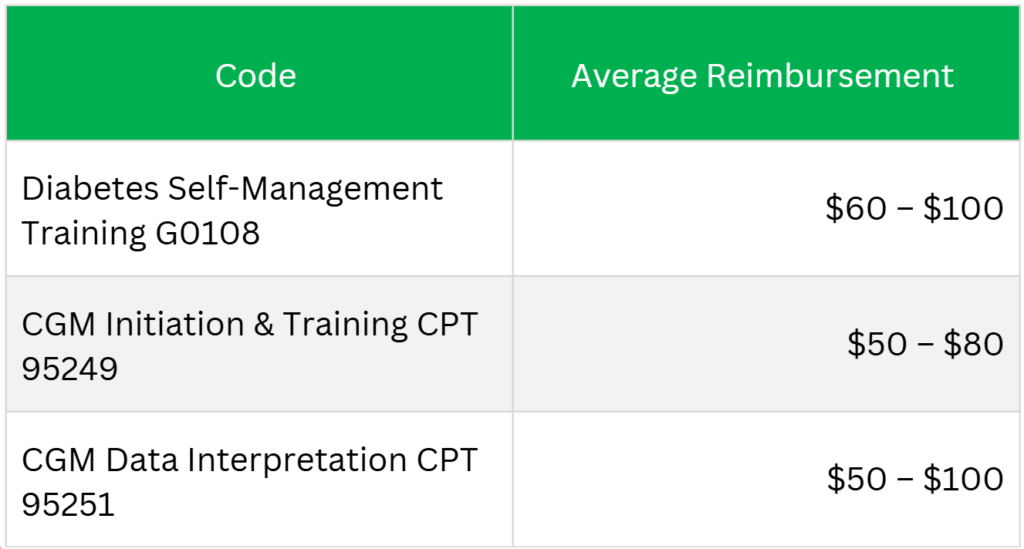
While reimbursement for CPT 99211 is modest ($15–$30), it enables ambulatory care pharmacists to account for workload, demonstrate value, and justify staffing through direct revenue capture and performance outcomes. Although CPT 99211 remains the foundation of pharmacist incident-to-billing, additional reimbursable services may be billed when they meet state scope of practice, additional accreditation standards, and supervision requirements. For example, the G0108 code may only be used for reimbursement when the service is provided under an accredited program recognized by an accrediting organization such as American Diabetes Association (ADA) or Association of Diabetes Care & Education Specialists (ADCES). Ambulatory care pharmacists currently leverage additional billing codes to increase reimbursement potential. These codes are commonly associated with advanced services such as diabetes education and continuous glucose monitoring (CGM):
Pharmacists in ValueBased Care and Performance Metrics
Pharmacistled care improves performance in highimpact clinical metrics tied to payer contracts and sharedsavings programs. American Society of Health-System Pharmacists identifies key indicators influenced by ambulatory care pharmacist involvement such as: ⁴
- A1C control in diabetes
- Hypertension management
- Medication adherence
- Reduction in hospital readmissions
- Completion of diseasestate monitoring and preventive health services
Value-Based Care Models increasingly rely on pharmacist interventions to improve Healthcare Effectiveness Data and Information Set, Medicare Star Ratings, and population health metrics, all areas where ambulatory care pharmacist involvement is strongly linked to financial incentives.⁵
Future Directions
As pharmacists in Florida advocate for provider status and adopt payment pathways in Medicare, Medicaid, and commercial plans, opportunities will arise for billing, collaborative practice expansion, and telehealth services. The American Society of Health-System Pharmacists’ Practice Advancement Initiative 2030 emphasizes the importance of credentialing, privileging, and payer contracting to ensure sustainable, compliant pharmacist billing models.⁶

Exploring these billing pathways ensures sustainability while maximizing the impact of ambulatory care pharmacist interventions on clinical outcomes and population health.
- Medication Therapy Management: Codes 99605–99607 for comprehensive medication reviews
- Chronic Care Management: Codes 99490, 99491, 99439 for non-face-to-face care coordination
- Transitional Care Management: Codes 99495, 99496 for post-discharge follow-up
- Annual Wellness Visits: Codes G0438, G0439 for preventive health assessments
Ambulatory care pharmacist integration enhances access, quality, and patient outcomes. Pharmacistled services create measurable clinical and financial benefits by enabling compliant incidentto billing, expanding billable service options, and strengthening valuebased care performance. The continued evolution of provider status expands opportunities for pharmacistled services and reinforces the essential role of pharmacists within interdisciplinary care teams.
References:
- Dietrich, E., & Gums, J. G. (2018). Incident-to Billing for Pharmacists. Journal of managed care & specialty pharmacy, 24(12), 1273–1276.
- REGULATION OF PROFESSIONS AND OCCUPATIONS, 465 PHARMACY U.S.C. § 1865 (2025).https://www.leg.state.fl.us/Statutes/index.cfm?App_mode=Display_Statute&URL=0400-0499/0465/Sections/0465.1865.html
- REGULATION OF PROFESSIONS AND OCCUPATIONS, 465 PHARMACY U.S.C. § 0125 (2025).https://www.leg.state.fl.us/statutes/index.cfm?App_mode=Display_Statute&Search_String=&URL=0400-0499/0465/Sections/0465.0125.html
- American Society of Health-System Pharmacists. (2024). Advancing healthcare: Key steps to implementing pharmacist provider status. ASHP.
- Clements, J. N., Emmons, R. P., Anderson, S. L., Chow, M., Coon, S., Irwin, A. N., Mukherjee, S. M., Sease, J. M., Thrasher, K., & Witek, S. R. (2021). Current and future state of quality metrics and performance indicators in comprehensive medication management for ambulatory care pharmacy practice. Journal of the American College of Clinical Pharmacy, 4(4), 390–405.
- American Society of Health-System Pharmacists. (2020). Practice Advancement Initiative 2030: Recommendations for advancing pharmacy practice through the next decade. ASHP.
This article was originally published in the FLORxIDA Times | April 2026, Issue 21.
Share
Discuss this in the FSHP Community
The FSHP Community is open to members and nonmembers. Join the conversation!